

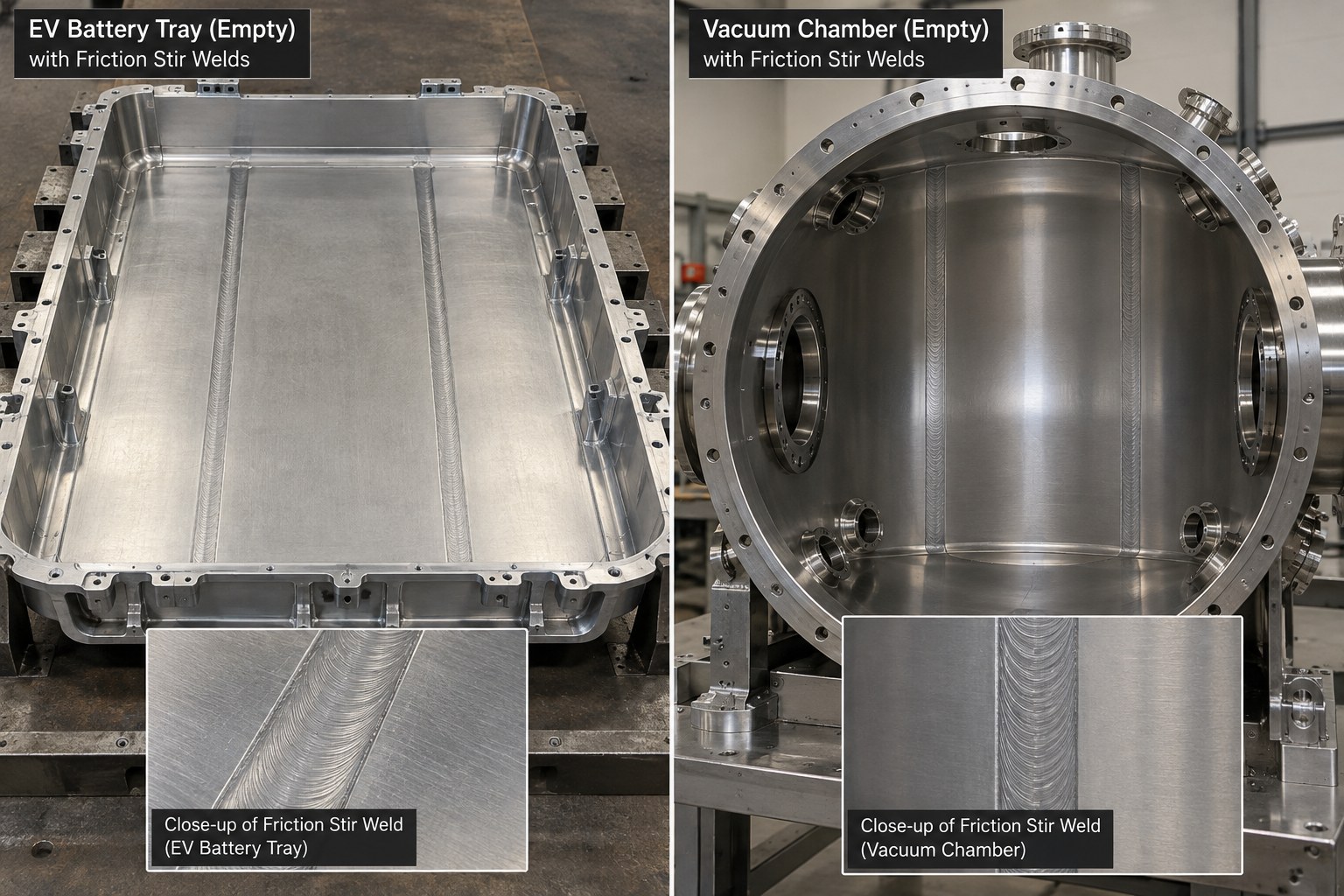
POROSITY
Porosity Eliminated
No melt pool means no solidification porosity or hot cracking, and the leak-tight seal that mechanical, gasketed, and brazed joints cannot reliably deliver.
Home / Technologies / Friction Stir Welding
Leak-tight, high-strength joints in aluminum and dissimilar metals, including alloys considered unweldable. Produced without filler, shielding gas, or post-weld straightening, and qualified to AWS D17.3.
What it does well
POROSITY
No melt pool means no solidification porosity or hot cracking, and the leak-tight seal that mechanical, gasketed, and brazed joints cannot reliably deliver.
SIZE
Join extrusions edge to edge to reach large structures such as cold plates and battery trays, while keeping extrusion-like properties.
STRENGTH
Substantially stronger than arc welding, with long fatigue life and proven cryogenic service.
MATERIALS
Aluminum-to-copper and bimetallic transitions, and high-strength 2xxx, 6xxx, and 7xxx alloys that crack under fusion welding, are routine for FSW.
How it works
A rotating tool plasticizes the metal on both sides of the seam and stirs it together without melting it. The result is a wrought, fine-grained joint substantially stronger than an arc weld, with minimal distortion and none of the porosity or hot cracking that come with a melt pool. It also joins metals that cannot be fusion welded at all, so a designer can pick the best alloy for the job rather than the most weldable one.
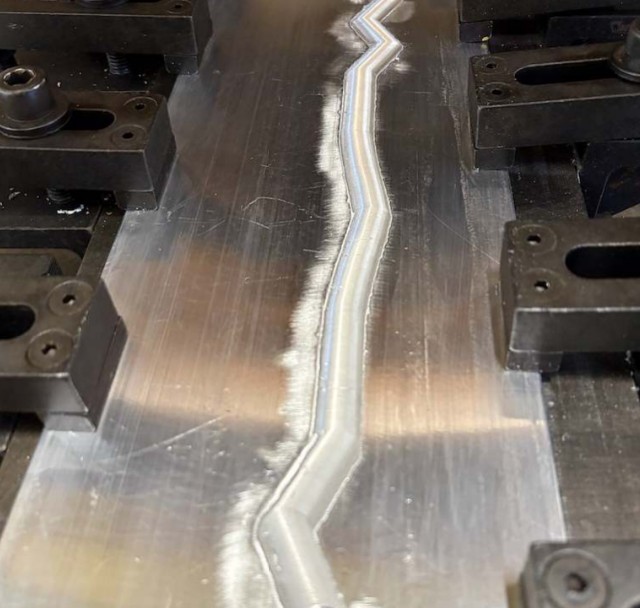
Pathway to production
Five steps, each built on your material, your geometry, and your part. You send us the drawing. We make the part and ship it back.
01
We tune the process for your material and your joint geometry, starting from your drawing.
02
The tuned process is qualified to AWS D17.3, a NASA specification, or your own specification.
03
We weld your article from your drawing, so you evaluate your own part, not a generic coupon.
04
The qualified process runs on your parts as demand builds, with no filler, no shielding gas, and no post-weld straightening.
05
The same qualified process scales to your full production volume.
Not sure where you are on this path? Send a drawing and we will tell you.
Send us a drawingWhere it is used
01
Structural and pressure-containing joints in aluminum weldments.
02
Cold plates and heat exchangers with a hermetic FSW closure.
03
Flight hardware joints qualified to AWS D17.3 and NASA specifications.
04
Hull structures, tailored welded blanks, and multi-material joints.
Next step
A drawing, a STEP file, or a sketch and a size is enough. We reply within 3 business days, including when the answer is no.