

01 · FEED
Aluminum Feedstock Goes in From the Side
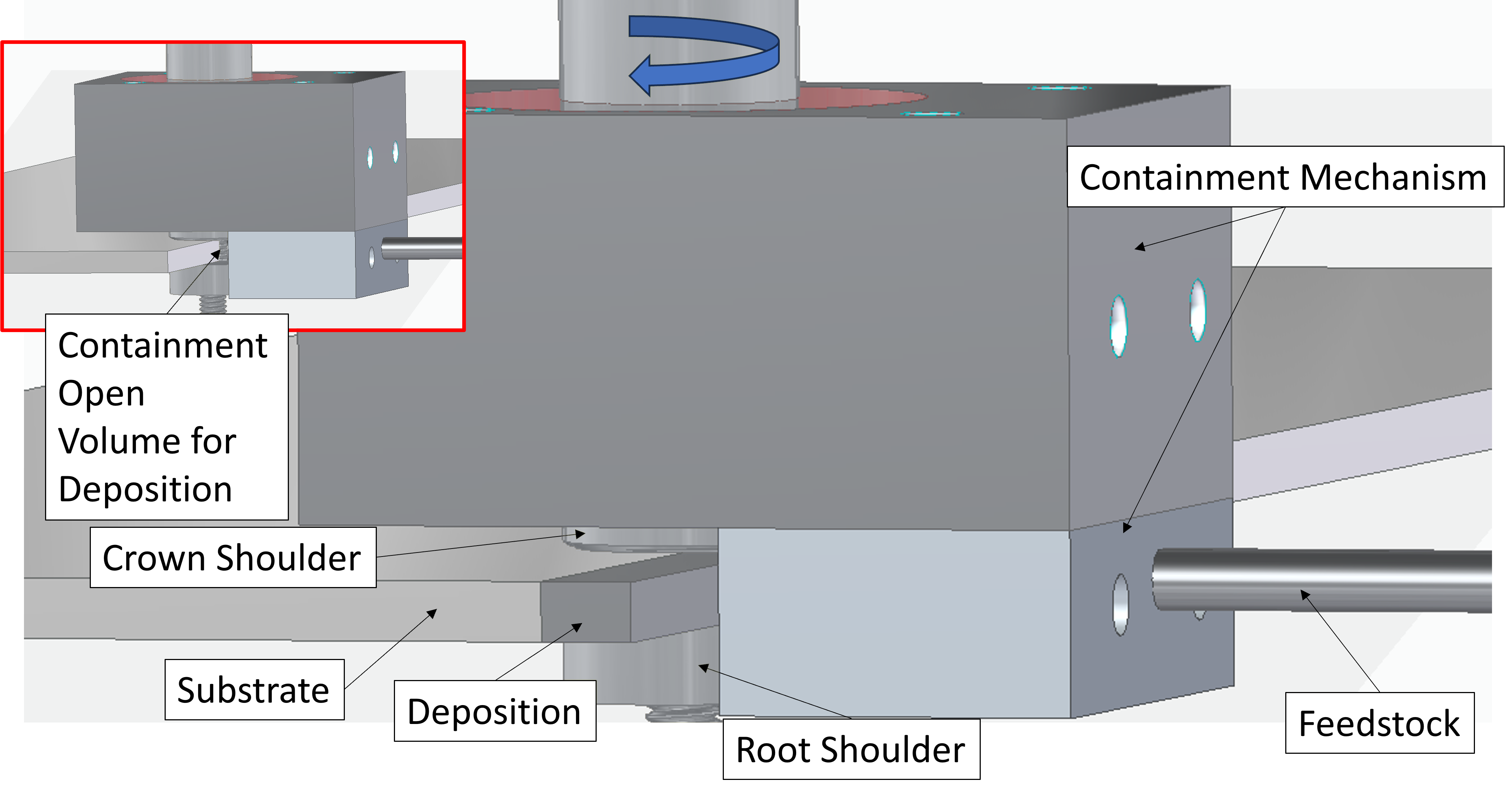
It enters an open volume between the containment block and the edge of the part.
Home / Technologies / Bobbin Friction Stir Deposition
A solid-state additive process for large metal structures.
Aluminum domeA seamless aluminum dome, built entirely with B-FSD and shown in blue.
In the missileSchematic cutaway of a stage: the oxidizer tank sits above the fuel tank, each closed by domed bulkheads. The domes, shown in blue, are the aluminum parts B-FSD can build.
01 · FEED
It enters an open volume between the containment block and the edge of the part.
02 · STIR
Crown and root shoulders clamp the plane while the pin drives plastic flow. Nothing melts.
03 · BUILD
Each pass extends the part in-plane, so rings, barrels, and domes grow without a forging die.
Value proposition
B-FSD gives large aluminum parts the strength of a forging without the die, the long lead time, or the minimum order.
SPEED
No inflexible forging die or casting pattern to make, and no queue behind one.
STRENGTH
A fine as-built microstructure with no solidification porosity or hot cracking.
FLEXIBILITY
No tooling to pay off, plus design freedom, part consolidation, and seamless multi-material structures.
REPAIR
Repair and feature addition on parts already in service, at the point of need.
How it works
Aluminum feedstock is fed laterally into an open volume bounded by the containment block and the substrate edge. Crown and root shoulders clamp the plane; the pin between them drives plastic flow. Peak temperature stays below the alloy's melting point.
The root shoulder reacts the crown shoulder's load through the workpiece, so no backing anvil is required. Tool and containment traverse together along the edge; each pass extends the part in-plane rather than stacking a layer on top.
B-FSD builds net shape, with no post-build machining.
Because nothing solidifies from liquid, the deposit has a wrought, fine recrystallized microstructure, not a cast one. No solidification porosity. No hot cracking.
Why solid-state
B-FSD plasticizes metal below its melting point and consolidates it under forging pressure, which is why the comparison below runs the way it does.
| Criterion | Forging | Casting | B-FSD |
|---|---|---|---|
| Lead time | Years | Months | Days to weeks |
| Hard tooling | Dedicated die per geometry | Pattern and mold | None |
| Porosity & hot cracking | Low | Inherent risk | None (no melting) |
| High-strength Al (2xxx/7xxx) | Standard | Poor castability | Forge equivalent |
| Multi-material structures | No | Limited | Seamless multi-material |
| Process loads | Very high press loads | None | Low; self-reacting tool |
| Machining | Extensive | Complex | N/A |
| Thin-wall structures | Limited by die | Limited by flow | Enabled |
| Equipment | Large press | Foundry | Modular end-effector on existing FSW equipment |
| Minimum economic quantity | Volume amortizes the die | Volume amortizes tooling | One |
| Point-of-need repair | No | No | Yes |
Questions engineers ask
No. You send us a drawing, and we manufacture the part. B-FSD runs on existing friction stir welding equipment, so LeapFast can deposit structures and solve your joining needs with the same equipment.
Yes. B-FSD is forge equivalent: a wrought, fine microstructure with no solidification porosity and no hot cracking.
Yes. Repair and feature addition onto existing aluminum structure is a core application (it is one of the reasons the process was invented).
To AWS D17.4 or to your specification. LeapFast qualifies friction stir welding procedures to AWS D17.4 and to NASA specifications, including for production flight hardware. LeapFast is also helping write the industry specifications for B-FSD. Work starts with a paid feasibility study and an agreed first-article plan.
B-FSD was developed by Zachary Courtright while at NASA. LeapFast holds an exclusive license to the NASA process and US Patent 12,157,179 B1.
Next step
Send a drawing or a STEP file. We come back within 3 business days with a manufacturing architecture and a rough cost delta, including when the answer is no.